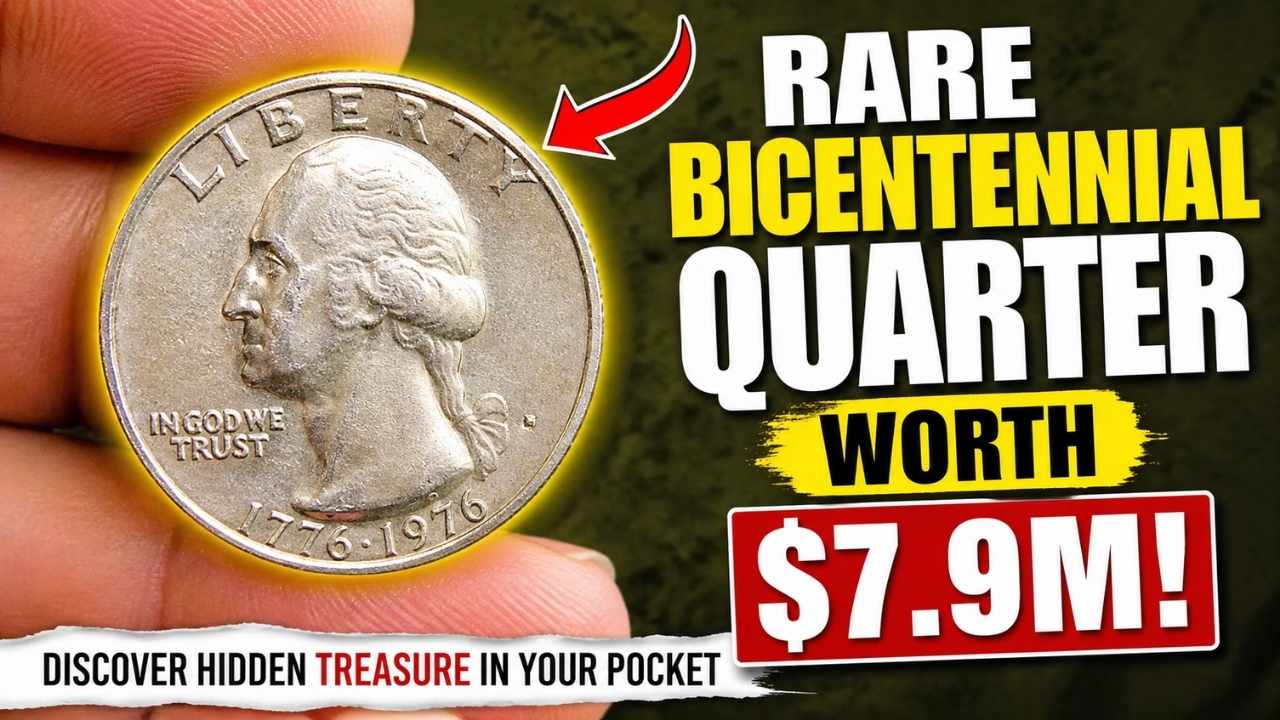
Rare Bicentennial Quarter Worth 7.9M: The 1776–1976 Bicentennial quarter is a landmark coin in United States history, issued to celebrate 200 years of independence. Millions were minted for circulation and collector sets, yet among them exists a rare variety that has captured the attention of collectors worldwide. Some of these coins, due to minting anomalies or unique characteristics, have skyrocketed in value, with certain examples reportedly valued at $7.9 million. Understanding the rarity, identifying features, and proper care of these quarters is crucial for anyone interested in discovering potential treasures in everyday change.
This guide explores the history of Bicentennial quarters, highlights the most valuable types, and provides practical advice for spotting and preserving rare coins.

Overview of the 1976 Bicentennial Quarter
The 1976 Bicentennial quarter features a dual date of 1776–1976, marking the nation’s 200th anniversary. The reverse design, created by Jack L. Ahr, depicts a colonial drummer boy with thirteen stars, symbolizing the original states. The obverse retains the familiar profile of Abraham Lincoln.
Philadelphia, Denver, and San Francisco produced these quarters. Philadelphia and Denver coins were intended for circulation, while San Francisco coins were issued as proof or uncirculated collector editions. Despite high production numbers, minting anomalies and rare variations make some of these quarters exceptionally valuable.
The Rare $7.9 Million Bicentennial Quarter
Reports of a Bicentennial quarter valued at $7.9 million have circulated among collectors, generally attributed to a combination of extreme rarity, historical significance, and a unique minting anomaly. Coins of this caliber are extraordinarily uncommon, often involving errors such as off-metal strikes, double dies, or unique die varieties not found in general circulation.
High-grade examples, particularly those with certified authenticity, can achieve astronomical prices at auction. Such coins are typically held in private collections and rarely appear on the market, making them legendary in the numismatic community.
Types of Valuable Bicentennial Quarters
Several types of Bicentennial quarters have proven to be more valuable than standard circulation coins. These include double die varieties, off-center strikes, die cracks, and missing or weak mint marks.
Double die errors display a doubling of the date or lettering, which is highly collectible. Off-center strikes occur when a coin is not aligned correctly during minting, leaving part of the design missing. Die cracks or breaks show as raised lines on the coin’s surface, adding uniqueness. Missing or faint mint marks are also highly sought after, especially when they occur in a limited number of coins.

Identifying Double Die Errors
Double die errors are among the most recognizable and valuable Bicentennial quarter anomalies. The doubling can appear on the date, lettering, or design elements. Collectors often use magnification to carefully examine coins for this feature.
Coins with pronounced doubling in high-grade condition can fetch significant premiums, especially when verified by professional grading services. Attention to detail is essential to distinguish authentic double dies from post-mint damage or wear.

Off-Center Strikes
Off-center strikes are dramatic errors that greatly enhance a coin’s value. These errors result when a coin is not properly aligned in the press, causing partial designs or incomplete features.
The value of off-center coins increases with the severity of the misalignment. Coins with large portions missing or clearly misaligned design elements are particularly prized. Proper authentication ensures that the coin is a genuine mint error.

Die Cracks and Die Breaks
Die cracks and breaks occur when the die used in minting develops a fracture, creating raised lines or irregular patterns on the coin. The more pronounced and unusual the crack, the higher the coin’s value.
Collectors often look for coins with visually striking or unusual die anomalies. Coins exhibiting these features in uncirculated or proof condition are highly collectible and command premium prices.

Mint Mark Variations and Errors
Some Bicentennial quarters feature missing or weak mint marks. Coins with a missing “D” or faint “S” mint mark are rare and collectible. These errors occurred due to die issues during production and are difficult to replicate, making them valuable.
Verification by magnification or professional grading is essential to confirm the coin’s rarity and legitimacy.

Proof and Collector Coins
San Francisco proof and uncirculated collector coins from 1976 often contain high-quality finishes and, in rare cases, minting errors. Proof coins exhibit mirror-like surfaces and sharp details, making errors more noticeable and collectible.
Collectors prize proof coins with anomalies because they are produced under controlled conditions, and any error present represents a true minting rarity. High-grade proofs can achieve exceptional auction prices.

Spotting Valuable Bicentennial Quarters
To identify potentially valuable quarters, examine the date, mint mark, and design carefully. Look for doubling, off-center strikes, missing elements, or unusual raised lines. A magnifying glass or loupe is helpful for detecting subtle errors.
Condition is critical; coins with minimal wear, original luster, and no corrosion are far more valuable. Early identification and careful handling can preserve a coin’s potential value.

Factors Affecting Value
Several factors determine the value of rare Bicentennial quarters. Coin condition, including grade, luster, and surface quality, is the most important factor. Type and severity of error also play a key role, with more dramatic or unique anomalies commanding higher prices.
Rarity, historical significance, and certification by recognized grading services enhance both value and marketability. Coins with verified authenticity are highly sought after and achieve premium prices at auction.
Storing and Preserving Rare Quarters
Proper storage is essential to maintain value. Coins should be stored in a stable, dry environment away from direct handling. Use protective holders, flips, or albums to prevent scratches, corrosion, and tarnish.
Regular inspection ensures early detection of potential damage. Coins in pristine condition maintain maximum value and appeal for collectors.
Conclusion
The 1976 Bicentennial quarter offers more than historical significance; it presents the possibility of extraordinary value for collectors who know what to look for. Rare varieties, including double dies, off-center strikes, die cracks, and mint mark anomalies, can reach remarkable prices, with some examples rumored to be worth $7.9 million.
By understanding error types, examining coins carefully, and ensuring proper preservation and certification, collectors and casual holders alike can identify hidden treasures. These quarters offer a unique blend of historical significance, rarity, and investment potential, making them one of the most intriguing and valuable coins in American numismatics.
Even coins found in everyday change may conceal astonishing value, emphasizing the importance of awareness, knowledge, and careful observation in the pursuit of numismatic treasures.